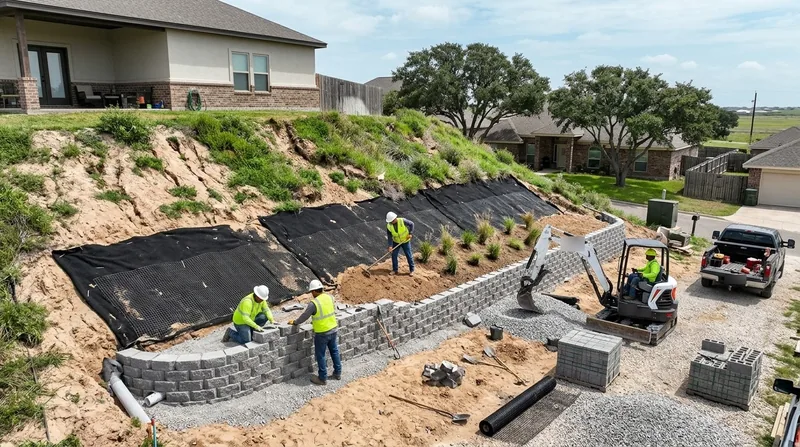




Corpus Christi sits on the flat Coastal Bend plain, but that flat ground breaks sharply at the old bluff above downtown and Ocean Drive, along the bayfront, and down into the Oso Creek and Nueces River valley at Calallen. Those edges, plus the loose sand toward Flour Bluff and Padre Island, are where yards slide, driveways crack, and fence lines creep downhill after a hard Gulf downpour. Slope Stabilization & Erosion Control in Corpus Christi is how we hold those edges in place with terraced walls, geogrid reinforcement, and drainage that moves water away from the slope instead of through it. If you own a bluff lot, a creek bank property, or a bayfront home with a failing grade, the fix starts with reading the soil and the water, not with stacking block. Call (361) 600-4114 and we will walk the slope with you. For walls that are already leaning or bulging, start with leaning and collapsed wall repair before the movement reaches the house.
Why Slope Stabilization & Erosion Control Matters on Corpus Christi Bluffs, Creeks, and Bayfront Lots
Most Corpus Christi retaining walls are low, poured concrete or CMU at driveways and pool decks, segmental block raised beds, and limestone or boulder edging on bayfront and creek lots. They fail for two reasons that have nothing to do with the block: dark shrink-swell clay inland that swells and shrinks with every wet and dry cycle, and loose sand near Flour Bluff and the island that washes out under the footing. Add a high water table, hurricane downpours, salt air, and bright humid Gulf light, and a slope that looks fine in March can be undercut by August.
- Water piles up behind a wall with no drainage and pushes the whole face outward.
- Shrink-swell clay inland swells after rain and lifts footings that were set too shallow.
- Loose sand on island and Flour Bluff lots washes out from under segmental block and boulder edging.
- Old railroad tie walls near the bluff rot at the soil line and release the slope they were holding.
- Downspouts and pool overflow dumped at the top of a slope cut a channel straight down the face.
We see the same pattern from Ocean Drive to Calallen: the wall is blamed, but the water is the culprit. Fix the water and the slope holds.
Key info: A Del Mar homeowner called us after a July downpour washed out six feet of a segmental block bed behind the pool deck. The block was fine. The wall had no gravel drain and no geogrid, so the clay behind it pushed the bottom course out. We rebuilt it with drainage and grid, and it has not moved since.
The City of Corpus Christi's building department sets the permit thresholds, and those thresholds vary, so verify the current rule before any work starts. You can review local permit requirements through the City of Corpus Christi before we schedule.
How We Stabilize a Slope in Corpus Christi, Step by Step
We do not guess at a slope. We read it. On a Calallen creek bank or a Padre Island canal lot, that means looking at where the water goes during a storm, what the soil does when it is wet, and how much load sits above the slope. Then we build the fix in the right order, because a wall built before the drainage is a wall you will rebuild.
- We walk the slope and mark the failure points, the water paths, and any structure within reach of movement.
- We test the soil by hand and by eye to tell shrink-swell clay from loose sand, since each needs a different footing and backfill.
- We terrace the slope with two or more shorter walls instead of one tall face, which cuts the load on each wall.
- We set geogrid in the compacted lifts so the wall and the soil behind it act as one mass.
- We install gravel drain, filter fabric, and weep points so water leaves the slope instead of loading it.
- We tie the surface back with boulder edging, native plantings, or concrete swales where the grade still runs.
Every slope gets a drainage plan before the first block goes down, and we do not close a job until water runs away from the wall, not into it.
Key info: On a bayfront lot near Rockport, a single 5-foot wall had already failed twice. We replaced it with two terraced walls at 30 inches each, geogrid in every other course, and a gravel drain at both footings. The slope has held through two hurricane seasons. See the same approach on our block and segmental retaining walls page.
Slope Stabilization Approaches We Use on the Coastal Bend
The right approach depends on the soil, the height, the water, and what sits above the slope. A low raised bed behind a Lamar Park ranch house is not the same job as a 6-foot bluff edge above Ocean Drive, and we price and build them differently.
| Approach | Description | Best for |
|---|---|---|
| Terraced segmental block walls | Two or more shorter walls stepped up the slope with geogrid in the lifts. | Bluff edges and creek banks with 3 to 8 feet of grade. |
| Geogrid-reinforced soil | Grid layers tie the wall face to the compacted soil mass behind it. | Tall walls and any wall carrying a driveway or structure above. |
| Boulder and limestone edging | Heavy natural stone set into the slope toe to break wave and runoff energy. | Bayfront lots, canal banks, and sandy Flour Bluff edges. |
| Drainage and surface control | Gravel drain, filter fabric, weep points, swales, and downspout extensions. | Every slope, and the first step on any wall rebuild. |
We match the approach to the soil and the water, not to a catalog page. If the slope needs boulder work at the toe and block above, that is what we build. You can see the natural stone side on our boulder and natural stone walls page.
Slope Stabilization & Erosion Control Cost in Corpus Christi: What to Expect
Every slope job starts with a free estimate, because no honest number exists until we see the grade, the soil, and the water. A low segmental block terrace on a Southside lot is a different scope from a bluff-edge rebuild with geogrid and engineered drawings, and the price follows the scope. Expect the cost to move with slope height, how much soil has to be removed and compacted, whether geogrid or engineered plans are required, access for equipment, and how close the work sits to the house, pool, or driveway.
- Slope height and the number of terraces drive the block count and the excavation.
- Shrink-swell clay inland needs deeper footings and more backfill than sandy island lots.
- Geogrid, drainage, and engineered drawings add cost but are what make the wall last.
- Tight access behind a pool deck or between houses slows the job and raises labor.
- Emergency work after a washout costs more than planned work done before the failure.
Get two or three estimates and compare what each one includes, not just the bottom line. A low bid that skips drainage or geogrid is a rebuild waiting to happen. Our pricing overview lays out the ranges, and the estimate call is free.
Hiring a Retaining Wall Contractor Near Me in Corpus Christi: What to Check
Slope work is unforgiving of shortcuts, so check the contractor before you check the price. Ask for the license and insurance certificate, and confirm the policy covers retaining and slope work, not just general landscaping. Get at least two or three written estimates that spell out drainage, geogrid, and backfill, because those are the line items a cheap bid leaves out.
- Confirm the contractor is fully insured and ask for the certificate before work starts.
- Ask for local references on bluff, creek, or bayfront slopes, not just flat-lot walls.
- Check who pulls the permit and whether engineered drawings are required for your wall height.
- Read your HOA rules on wall height, material, and setback before signing anything.
- Walk away from any bid that does not mention drainage or compaction.
A contractor who cannot explain how water leaves your slope will not build a wall that holds. Reach us through our contact page or call (361) 600-4114, and we will walk the slope with you and put the plan in writing.
Slope Stabilization & Erosion Control in Corpus Christi: Pricing Guide
| Service | Price | Details |
|---|---|---|
| Slope stabilization estimate | Free estimate | On-site walk of the slope, soil check, and a written scope before any number is given. |
| Low terrace or raised bed rebuild | Starting at $2,800 | Segmental block terrace up to 3 feet with gravel drain and compacted backfill included. |
| Geogrid-reinforced slope wall | Starting at $6,500 | Terraced walls with geogrid, drainage, and filter fabric; height and access move the price. |
| Bluff or bayfront engineered rebuild | On estimate | Engineered drawings, boulder toe, and multiple terraces need an on-site look first. |
| Travel | Included | In Corpus Christi and surrounding areas, no separate call-out or mileage fee. |
| Estimate | Free | Response within 24h at (361) 600-4114, no obligation to book. |
Indicative pricing, the exact cost depends on square footage, finish, and site access. Free personalized estimate within 24h at (361) 600-4114.


